From the annual — a life, told at length
Balwant Singh
Halwai, Singh Sweet House (Since His Grandfather's Time)
“He sweetens every occasion and attends none of them.”
The Life, Told at Length
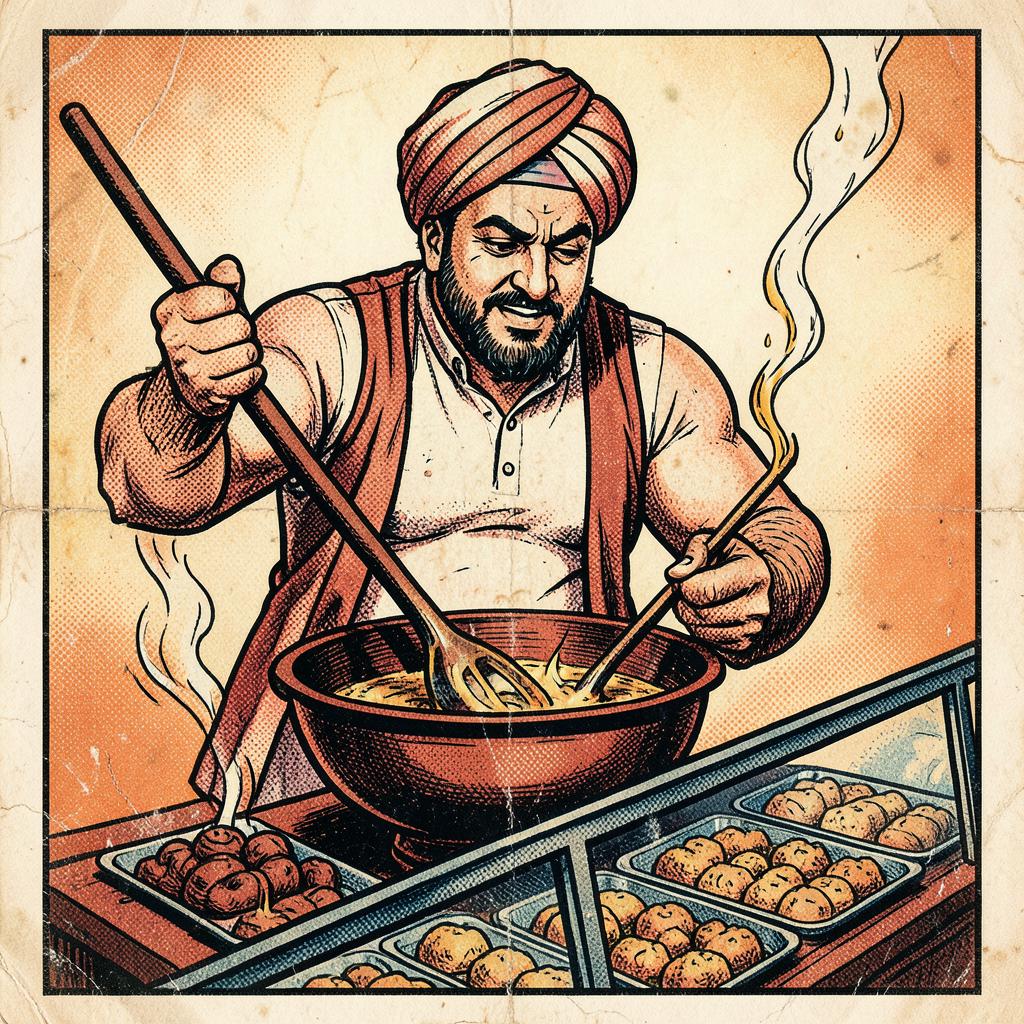
Balwant Singh was born into the kadhai, in the sense that Singh Sweet House was already forty years old and thick with the smell of ghee and cardamom by the time he was old enough to be handed a wooden ladle and told to stir without stopping. His grandfather had set up the shop after Partition with a single kadhai, a borrowed handcart, and a recipe for barfi he refused, for his whole life, to write down anywhere.
Balwant's father ran the shop through the sixties and seventies with two sons at his side, Balwant the younger of the two, and it was understood, in the unspoken way such things were understood back then, that the elder son would eventually get the family's small piece of farmland outside town and the younger would get the shop — a split that looked fair enough on paper, but in practice left Balwant with a business that also carried, quietly attached to it, his father's outstanding debts to two suppliers and one moneylender.
He has never spoken a word against the arrangement, not to his brother, not to his wife, not to the two nephews from his brother's side who now farm the land their father once farmed. Every festival, without fail, Balwant sends two kilos of the shop's finest across town to that brother's house — motichoor at Diwali, gujiya trays at Holi — packed by his own hand, weighed twice, and never once billed.
The shop itself opens at four in the morning, when the milk arrives and the first kadhai of the day goes on the flame, and Balwant can judge how ready a syrup is just by its bubbling sound from the next room, without needing to look, a skill his father had and his father's father had before him — one that no thermometer, in Balwant's firm opinion, will ever replace.
His forearms carry the scars of forty years near an open flame, small pale patches from spitting oil and careless brushes with hot syrup, and he wears them the way other men wear medals, mentioning them only when a customer asks and never otherwise.
The colony marks every occasion that matters through his counter — births announced with laddoo, exam results celebrated with barfi, and even the more solemn occasions demanding their own particular sweet, which Balwant prepares with exactly the same care whether or not the day being marked is a happy one. Over the decades he has become less a shopkeeper than a kind of civic institution, present in every family's good news before the family itself has finished telling everyone.
He tastes constantly through the working day, a pinch from the ladle, a sliver off the tray, checking texture and sweetness with the seriousness of an examiner, and yet at home in the evening he will take nothing sweet at all, waving off his wife's offer of dessert with the same line every night — bas, whole day it is there in the mouth already — a claim his wife has stopped questioning though she has never quite believed it either.
There was a hard year in the early nineties when sugar prices rose sharply and two rival sweet shops opened within walking distance, cutting into custom that had once been entirely his; Balwant answered not by lowering his own quality but by holding a mela outside the shop for three days, giving out small samples free to anyone who passed, and within a month the competitors had scaled back their ambitions considerably.
He has no plans to retire, and no one has yet worked out, Balwant included, which of his two sons — one in an office job in the city, one still deciding — might one day take the kadhai from him; and until that question settles itself he carries on exactly as he always has, at four each morning, stirring, tasting, judging syrup by ear, sending sweets across town to a brother who took the land and said nothing, and getting back nothing but silence, which Balwant has, for forty years, chosen to answer with sugar.