From the annual — a life, told at length
Bharati Nayak
Owner, New Glow Ladies' Beauty Parlour (First Floor)
“She hears every secret in the colony and keeps only her own.”
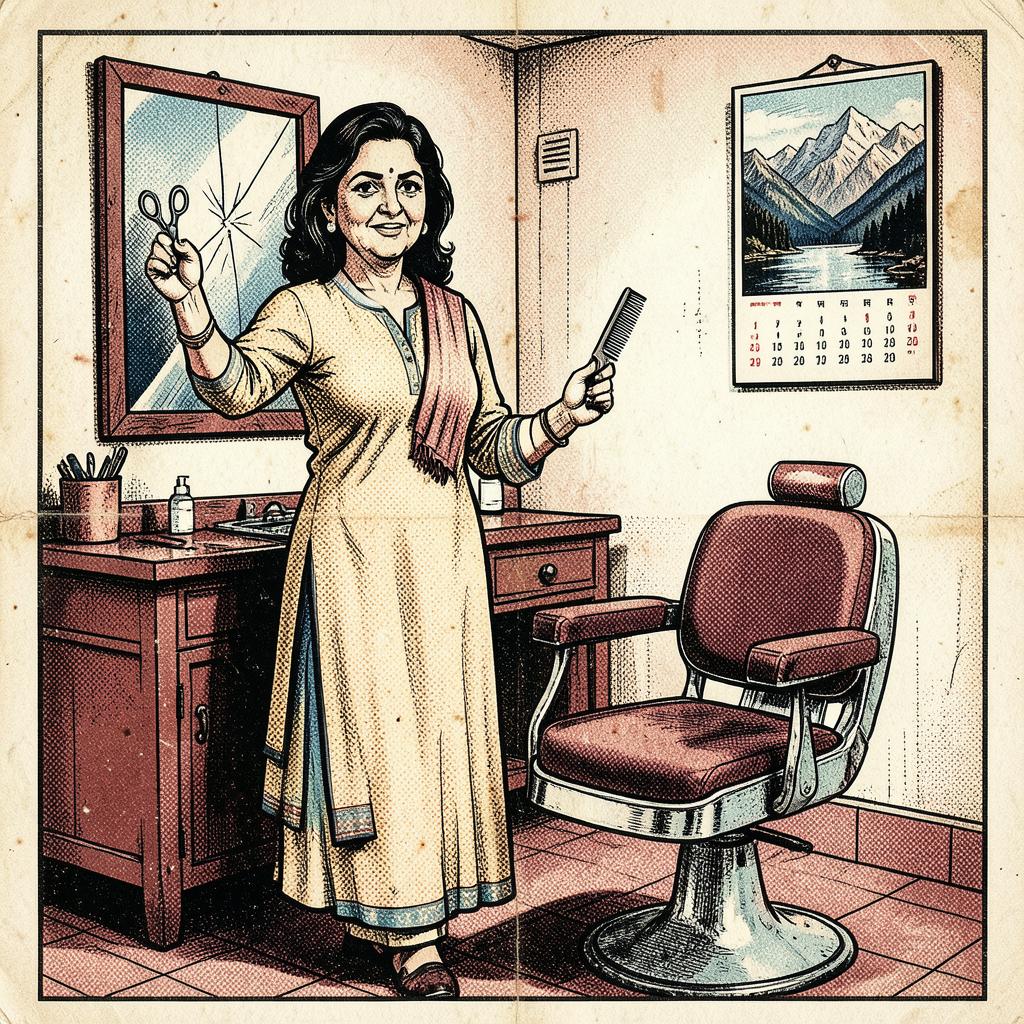
The Life, Told at Length
Bharati Nayak grew up above her father's cloth shop in a lane just off the main market, one of two daughters in a household that prized neatness, correct behaviour, and paying debts on time above almost everything else. She married at twenty-two into a family that looked, by the evidence available then, entirely sound — a husband with a small hardware business, a mother-in-law who approved of her, a future that needed no particular imagination to picture.
The hardware business collapsed in a mess involving a partner, a cheque, and a court order, and within a year the shop shutters were sealed by the bank. What followed, in Bharati's own brief words, was "eleven months of asking," during which relatives who had eaten at her table for a decade suddenly found urgent prior engagements whenever her name came up alongside the word loan. She borrowed, eventually, from three people charging three different rates of interest, and she has never forgotten a single figure.
She began with a tin of wax, a borrowed steel almirah standing in for a mirror stand, and a first-floor room above the tailor's that nobody else wanted, since the stairs were narrow and the ceiling fan wobbled. New Glow opened with two mismatched plastic chairs and a single working light bulb, and the first customers were neighbours who came, at first, out of something between curiosity and pity.
The pity did not last, because Bharati turned out to have genuine hands — quick, economical with thread and wax, leaving no redness, with an instinct for the haircut a face actually wanted rather than the one asked for. Within three years she had two chairs, a proper mirror, and a clientele that included women from two colonies away who came specifically for her and not the cheaper parlour down the road.
Every rupee she borrowed she repaid in full, ahead of schedule wherever she could manage it, partly out of pride and partly, she'd admit if pressed, because she wanted the exact pleasure of settling accounts with each of those three relatives, one by one, in as pleasant a tone as she could manage.
Over the years the parlour has become the place where the colony's real news gets exchanged — brides sit in that chair on the last unmarried morning of their lives, and more than one marriage has been declared over there before either family was formally told. Bharati has heard every version of every story the neighbourhood tells about itself, and she has never once repeated a confidence, a discipline her customers rely on even more than her scissors.
There is a packet of something sweet in the drawer under the combs — boiled sweets some weeks, a piece of barfi from a grateful client other weeks — and it disappears steadily through the working day, which Bharati blames on the long hours and waves off if anyone remarks on it.
Her daughter, now in school, spends her afternoons doing homework on the second plastic chair while her mother works, and Bharati has made it plain, in the flat, unarguable way she makes most things plain, that this daughter will finish her studies before anyone brings up marriage in this house — a line she delivers to any relative who raises the subject with the same steadiness she once used to talk down an unreasonable rate of interest.
The Swiss lake calendar on the wall is eleven years old and has never been changed, less out of sentiment than because nobody has got around to it, and it now looks down on a business that owes nothing to anybody — which, in that room, on that first floor, above the tailor's, counts as the whole of the achievement, and is spoken of by nobody, least of all Bharati, as anything less.