From the annual — a life, told at length
Bishnu Prasad Barman
Retired Upper Division Clerk, Sub-Divisional Office
“Thirty-eight years of files, and not one word out of place.”
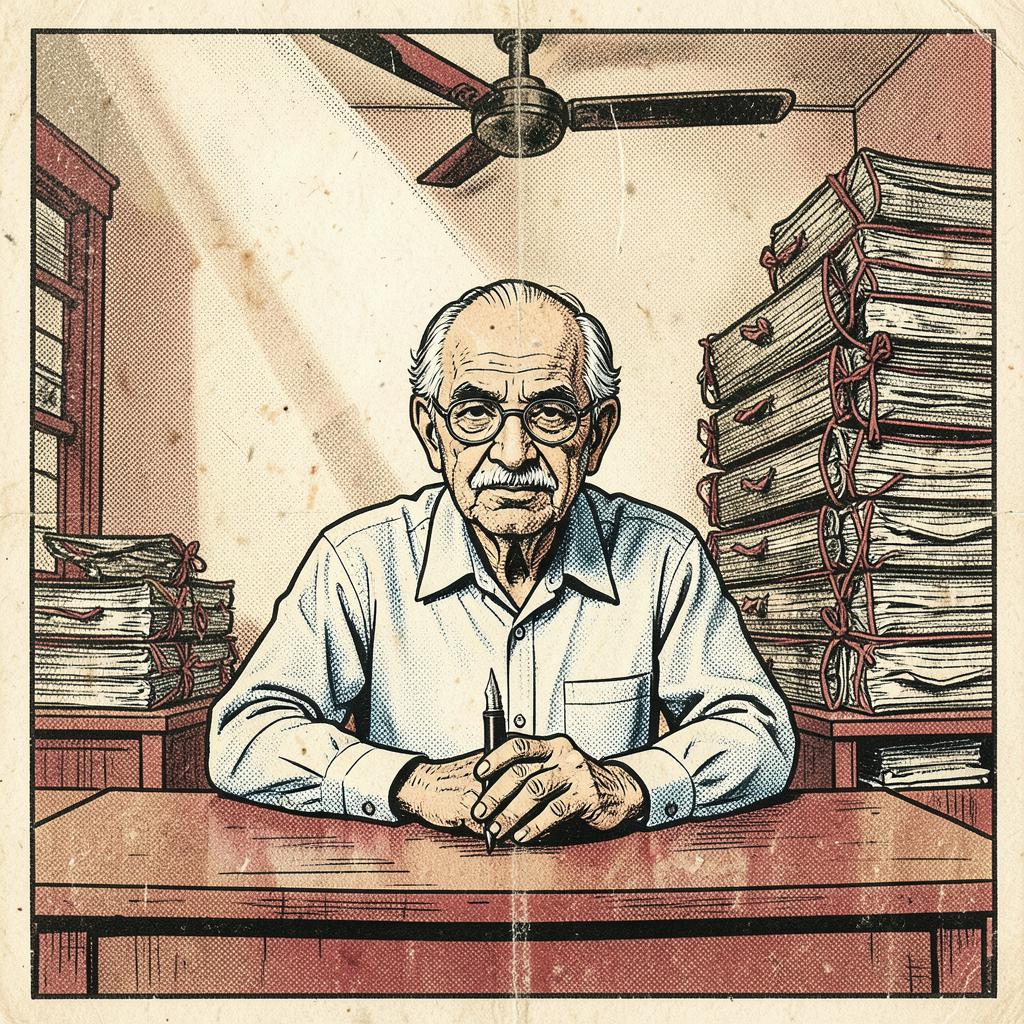
The Life, Told at Length
Bishnu Prasad Barman was born in a small tehsil town in Assam, where his father kept accounts for a tea estate, and from the age of nine he was made to copy pages of his father's ledgers as handwriting practice — a discipline he resented then and credits now with everything that followed. By the time he sat his matriculation, his hand was already the kind that clerks twice his age would later ask him to imitate on a tricky form.
He joined the Sub-Divisional Office as a lower division clerk in 1961, a slight young man in a pressed shirt who arrived forty minutes before opening and stayed until the last file was correctly shelved. Promotion to upper division clerk came in 1974, bringing with it the land mutation register, the pension files, and a drawer of keys that only he was trusted to carry.
Three Sub-Divisional Officers came and went during his years of service, each one transferred onward to a bigger posting while Bishnu Prasad remained, because a district cannot run without someone who remembers, without consulting a single paper, which parcel of land was disputed in 1968 and how it was finally settled. Junior clerks called him Barman Babu and brought him their mistakes before anyone else could find them.
In 1989 a mutation order came down with instructions attached that were never written but well understood, and Bishnu Prasad was asked, quietly, by a man senior to him, to see that a certain document did not survive the monsoon. He filed it instead, correctly, in its rightful place, and said nothing further to anyone about the matter. Eleven months later his transfer order arrived, sending him to a subdivision two days' journey away by bus and boat, where he served without complaint until his record was quietly restored.
He married Renuka in 1965, a match arranged through a cousin, and together they raised two sons and a daughter in a government quarter with a guava tree that Bishnu Prasad pruned himself every winter with the same exactness he brought to his files. The elder son is an engineer in Guwahati now; the daughter teaches; the younger son runs a small provision shop and still asks his father to check his stock register once a month, “just to see it is in order.”
Retirement came in 1999 after thirty-eight years of service, marked by a function in the office hall, a garland, a clock that still keeps correct time on his wall, and a speech in which the new SDO, a young man half his age, said the district's registers had never since been so reliable. Bishnu Prasad accepted the compliment with a small nod, and pointed out afterwards that the clock had been wound one turn too many.
These days he wakes at the hour he always woke, walks to the market himself though a grandson would gladly go instead, and keeps his own small kingdom of the household in the same order he once kept a subdivision's paperwork: the electricity bill paid on the second of the month, never the third, the milk account balanced weekly, the slippers by the door aligned in pairs. Renuka long ago stopped remarking on it and simply sets right what she likes once he has gone out.
On winter evenings the neighbourhood children are sent to him for help with their arithmetic homework, and he corrects their sums with the same fountain pen he carried to office for three decades, refilled from the same bottle of blue-black ink he has bought from the same shop since before some of their fathers were born.
There is a story, told more by others than by him, about the eleven years he spent in a bad posting for refusing a small dishonesty, and if you ask him about it directly he will look faintly puzzled, as though asked to recall the weather on a particular Tuesday, and say only that a clerk's duty is to keep the register correct, and that this, surely, needs no explanation to anyone.