From the annual — a life, told at length
Girish Kulkarni
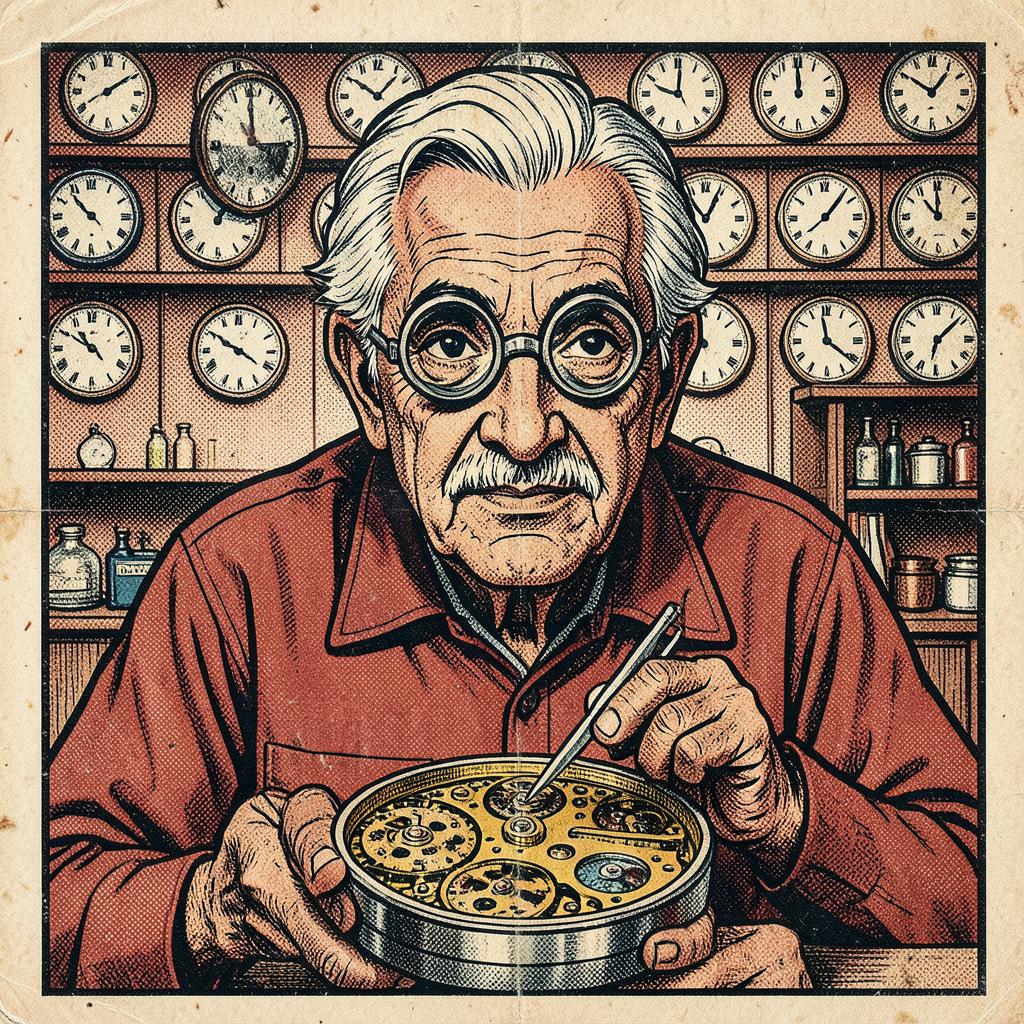
Watch & Clock Repairer, Stall No. 9, Old Market Arcade
“The most patient man in the market, and the least at peace.”
The Life, Told at Length
Girish Kulkarni's father ran a small stationery shop two lanes from the Old Market Arcade, and it was in the back room of that shop, when Girish was eleven, that he first opened up a broken alarm clock with his mother's hairpin and found, to everyone's mild surprise, that he could put it back together in working order by teatime. The clock belonged to a neighbour who had already written it off as scrap, and when it rang the next morning at the right hour, the whole lane briefly treated Girish like a small celebrity.
At fourteen he was apprenticed to an old Parsi watchmaker named Mr. Batliwala, who kept a stall in the Arcade before Girish inherited both the stall number and the trade. Over six patient years, Mr. Batliwala taught him that a watch is not a machine but an argument between metal parts, one that must be gently persuaded, never forced, into agreement. By the time Girish turned twenty, the old man's hands had grown too unsteady for the finer movements, and he handed over his tools — the eyeglass, the tweezers, the oiler — with a formality that struck the boy as excessive back then, and has struck him as exactly right ever since.
Stall No. 9 has not moved in thirty-odd years, though the Arcade around it has been repainted twice, flooded once, and threatened with demolition on no fewer than four separate occasions by no fewer than four separate municipal schemes, none of which ever came to anything. Girish arrives at nine, sweeps his own three feet of floor, sets out the velvet tray, and waits, with the patience of a man who has made peace with waiting, for the day's customers to find him.
In the seventies and eighties, business was steady: railway men who needed their watches exact to the minute, schoolteachers, and a few doctors who wore their fathers' Rolexes and trusted no one else to touch them. Girish married in 1974, a match arranged through his mother's cousin, to a woman named Sudha who ran a small tailoring business from their front room and never once, in all their years together, asked him to consider a more reliable line of work.
Quartz watches arrived in the early eighties like a slow tide, and Girish watched half the stalls around him switch to selling the cheap new imports, batteries included, no repair needed. He did not switch. When asked why, he says that a man who has spent forty years learning to listen to a mainspring cannot in good conscience spend his remaining years selling something that needs no listening at all — and he says this without any bitterness, the way another man might simply state the time.
One night in 1988, a retired sessions judge brought him a pocket watch that had stopped on the day of the judge's father's death some forty years earlier, and asked, almost apologetically, whether it could be made to run again without losing that date — which was of course impossible, since a watch that runs will not stay stopped. Girish explained this as gently as he could, then spent eleven unpaid hours restoring the mechanism to full working order anyway, so the judge could wind it once a year, on that exact date, let it run for a day, and stop it again himself. The judge came back every year after that, on the same afternoon, for the rest of his life.
His two sons went into entirely different trades — one an electrician, the other in a bank in Pune — and neither shows much interest in ever sitting at Stall No. 9 after him, a fact the neighbourhood discusses with far more sorrow than Girish himself seems to feel. He has trained one young apprentice from the colony, a boy named Anand, more out of habit than any real hope of succession, correcting the boy's grip on the tweezers with the same unhurried firmness Mr. Batliwala once used on him.
Every evening, Girish walks home along the same route he has walked for three decades, stopping at the same paan shop, exchanging the same seven words with the same shopkeeper, and Sudha has his tea ready by the time he climbs the stairs, the whole day folding shut behind him with the quiet click of a case being closed.
The Arcade's newer tenants call him Kulkarni Kaka now, out of respect rather than familiarity, and bring him their children's toy watches to fix, free of charge, because a shop that has survived this long has earned the right to seem a little magical to people who were not even born when it opened. Girish takes the toy watches just as seriously as anything else that lands on his tray, screws in his eyeglass, and gets to work.