From the annual — a life, told at length
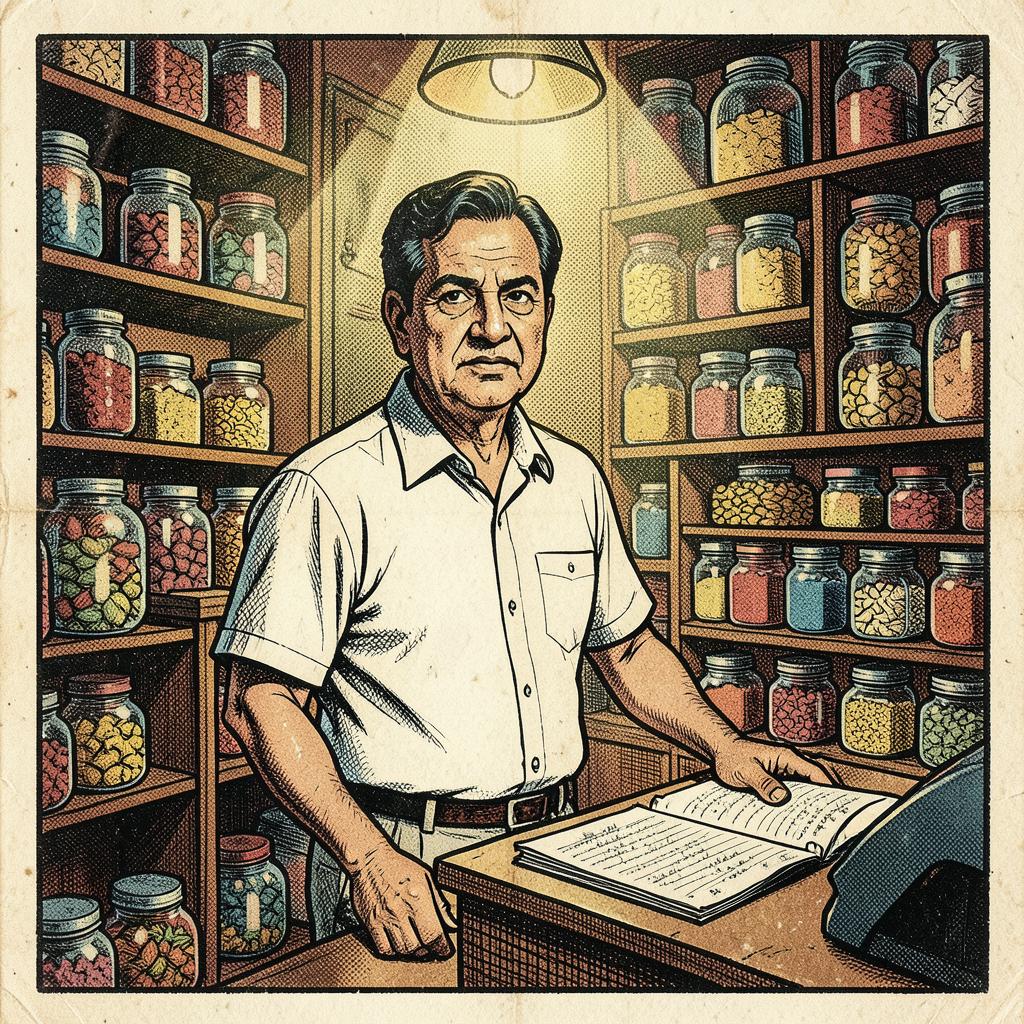
Hukum Chand Sethi
Proprietor, Sethi General Store (Est. 1971)
“He knows the price of everything, including silence.”
The Life, Told at Length
Sethi General Store stands on the corner where the colony road curves towards the water tank, and it has stood there since 1971, when Hukum Chand's father set down the first tin trunk of stock and Hukum Chand — twenty-two years old, freshly back from a course he never completed — arranged the jars himself, tallest at the back, smallest at the front, exactly the way a shop should be arranged.
He was the second of three sons, the one who was “good with figures,” which in that household meant he would inherit the ledger rather than the land. His elder brother took the family's two acres by the canal; his younger brother joined the army and writes home twice a year, always in October and again in April. Hukum Chand got the counter, the jars, and a set of brass weights that still ring true on the old scale.
In the early years the shop stocked only what the colony needed and nothing more — soap, matches, hing, thread, an occasional tin of Horlicks for a sick child. Over three decades it grew sideways rather than upward: a shelf of biscuits, a fridge for cold drinks bought on instalment, a rack of school notebooks each June. Hukum Chand never took over the neighbouring shop when it fell vacant in 1985, though everyone urged him to. “This much is enough for one man to look after properly,” he said, and returned to totting up the milk accounts.
The colony has watched three generations pass through that doorway. He remembers the diabetics and tells them, gently, that today's good sweets are finished. He remembers the boy who failed his Intermediate twice and now sells insurance two streets away, and greets him each morning as though he were still that boy with the cricket bat under his arm. Children are given toffees on a running credit that everyone, Hukum Chand included, knows will never be collected; it is simply how a shop like his says good morning.
There was a season, in the mid-seventies, when the shop nearly changed hands. A cousin from Karnal offered to buy the lease and start a wholesale cloth business instead — better money, he said, and easier hours. Hukum Chand's father was unwell that year, and the family gathered twice to discuss it over tea that went cold both times. In the end nothing was decided, which in that family counted as a decision, and the jars stayed exactly where they were.
He married in 1976, a quiet woman named Kaushalya from two villages away, and they now have a daughter settled in Ludhiana and a son who helps at weekends and complains, fondly, about the state of the storeroom. Sunday evenings the family sits on the veranda behind the shop, and Hukum Chand tells the same three jokes he has told for twenty years, and everyone laughs anyway, because the telling is the whole point.
One July the water tank overflowed and flooded half the lane, and Hukum Chand stayed up till two in the morning shifting sacks of atta onto the higher shelves, refusing every offer of help, insisting each time that it was “a very small thing,” while three neighbours stood outside handing him buckets all the same. By morning the shop was dry and open at its usual hour, and nobody who bought their milk that day knew what the night had cost him.
He keeps a small photograph tucked behind the till, of a building in Bombay he has never visited, cut from an old magazine years ago for no reason he has ever explained, and when customers ask about it he says only that it is “a nice building, no,” rings up their purchase, asks after their health, and reaches for the jar of lemon drops nobody actually ordered.
Ask Hukum Chand how business is, any day of any year, and the answer comes before the question is even finished: very good, very good. Behind him the jars catch the afternoon light exactly as they have for thirty-one years, and the colony goes on trusting a man who has never once, in three decades, been seen to raise his voice, lose his patience, or pull down the shutter before the last customer of the evening has been properly served.