From the annual — a life, told at length
Jagdish 'Jaggu' Rane
Wedding Photographer, Rane Colour Studio
“Four thousand happiest days of other people's lives.”
The Life, Told at Length
Jagdish Rane — Jaggu to everyone from the milkman to the municipal corporator — inherited his camera from an uncle who had used it for exactly one purpose: photographing a single disputed boundary wall for a court case that ran eleven years and settled nothing. Jaggu, fifteen at the time, found the Rolleiflex far more interesting than the boundary wall and began, without much permission, photographing everything else instead.
In the years that followed he wanted to be a photojournalist of the serious kind — the kind whose pictures appeared in the big Bombay magazines, the kind who went to the border during the '71 war or covered the floods in Assam, the kind whose name was printed under the photograph in small capital letters. He sent two portfolios to two publications in his early twenties and got back one polite rejection and one no reply at all, which he has always considered the ruder of the two.
Around the same time his father's small provisions shop was sold to pay off a debt, and the family needed income faster than a photojournalism career in Bombay was likely to produce. A neighbour getting married needed someone cheap to photograph the wedding; Jaggu had a camera and no better offer. He was paid eighty rupees and a large plate of food, and within two years he had a studio — one room, a hand-painted backdrop of a garden that existed nowhere, and a sign reading Rane Colour Studio, though for the first decade everything he shot was black and white.
Rane Colour Studio still stands on the same lane, its backdrop long since replaced by three different ones depending on the season, and Jaggu still develops his own film in a back room that always smells of fixer and dust — a smell his assistants have learned, without any irony, to call the smell of a proper photograph.
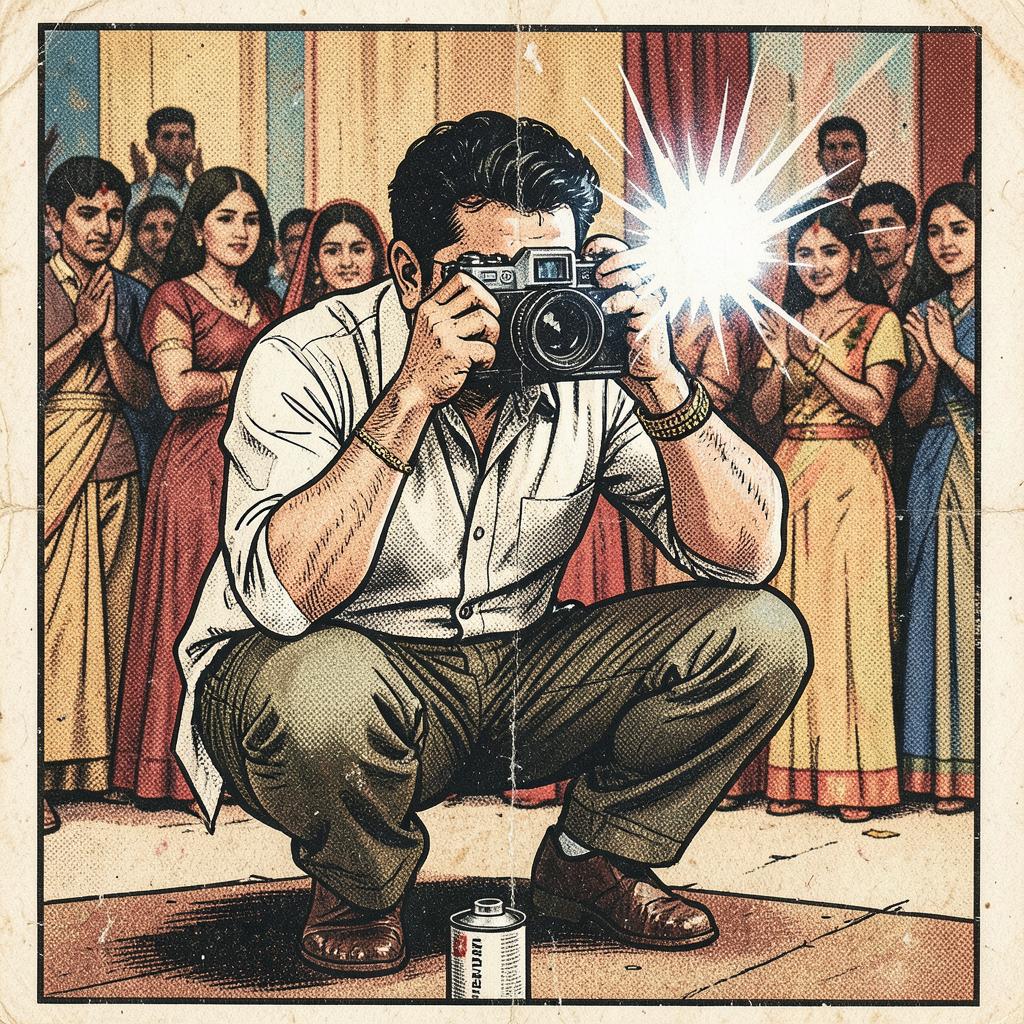
At a wedding he is less a hired hand than a small dictator, arranging seventy relatives into rows with two words and a raised finger — chhote log aage, small people to the front — and an instinct, sharpened over four thousand functions, for the exact half-second when the bride's mother's face will do something worth keeping forever. Three generations in the neighbourhood know his voice before they ever properly see his face, since by the nature of the job he is always the man behind the flash rather than in front of it.
He eats last at every wedding, after the guests, after the family, often standing near the kitchen with a plate balanced on one arm while he checks the day's shots on the back of the camera, and more than once he has photographed the ruins of the buffet table itself — the wilting garlands, the emptied trays, the one abandoned chair — for no client, and for no reason he has ever explained to anyone who asked.
In 1996 he bought a roll of black-and-white film meaning to shoot something of his own choosing on a free Sunday, but the free Sunday never quite came; the roll still sits in his cupboard, unopened, filed by year like everything else in that room, among four thousand other people's happiest days.
There was a season, not long ago, when a photographer from the city arrived with a digital camera and undercut every studio in the market, and Jaggu's business slowed for the better part of a year before steadying again, because it turned out the mothers of brides still preferred a man who would take a whole roll to get one correct frame of the mangalsutra over a boy who took four hundred frames of everything and called it coverage.
He is, by now, more an institution than a man, the fixed point around which half the neighbourhood's photo albums revolve, and if you ask him whether he minds having photographed everyone else's happiest day for thirty years instead of the mountains and the flood and the famine he once dreamed of, he will laugh, adjust the strap on his neck, and tell you, quite reasonably, that a man must eat — before turning his lens on whichever small child has just wandered, gloriously, into the wrong part of the frame.