From the annual — a life, told at length
Kamala Iyer
Assistant Teacher, Class VI-B, Municipal Girls' School
“She has raised four hundred children and named none of them.”
The Life, Told at Length
Kamala Iyer was the third of five daughters in a Palakkad household where educating girls was considered, in her father's words, “not wasteful, provided it is put to use,” and she was put to use early, teaching her younger sisters their multiplication tables at a kitchen table lit by a hurricane lamp long before she ever stood in front of a blackboard for money.
She trained as a teacher in Coimbatore, one of eleven girls in her batch to specialise in geography, a subject she chose because her professor, an elderly Bengali gentleman with a passion for river systems, made the Deccan plateau sound like a love story. She joined the Municipal Girls' School in 1976, Class VI-B her very first posting, and has not left that room since, though the paint has been redone four times and the blackboard itself replaced twice.
A marriage was arranged for her in 1996, to a bank officer from a good family two towns away, and the horoscopes matched well enough that the elders were satisfied. Three weeks before the date, the young man met with a scooter accident that left him needing a long convalescence, and amid the postponements and further consultations of the horoscope, the match quietly came undone, without anyone quite deciding to end it. Kamala speaks of that year only in connection with the school, which she joined, she says, “very fortunately,” that same season, as though the two events were simply neighbours in time.
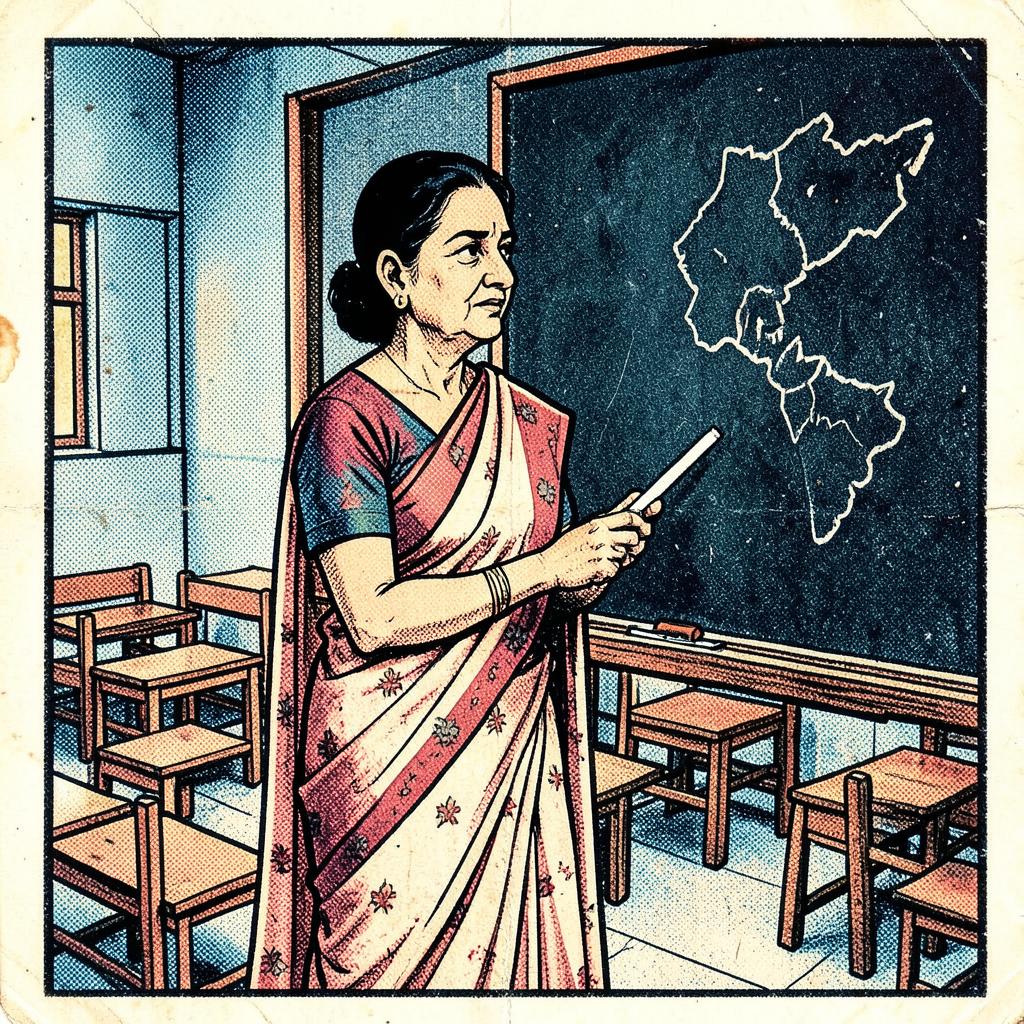
She can still draw the outline of peninsular India freehand on a blackboard, chalk moving without hesitation from Kutch to Kanyakumari, narrating the monsoon winds as she goes, to girls who sit very still because Madam's maps are, by long tradition, not to be interrupted. She remembers old students by their roll numbers from decades past — 14 of 1981, 22 of 1994 — faster than she remembers most adults' names, and asks after their mothers with a precision that unsettles former students meeting her again at forty.
Every Deepavali, sweets arrive by post and by hand from six districts, sent by women who were once small girls in her classroom, and Kamala keeps the wrappers and ribbons in a tin box atop her almirah, not out of any sentiment she would admit to, but because, she says, “good paper should not be thrown.”
In 1988 a girl named Radha in her class was withdrawn from school by her family after Class VII to be married off early, and Kamala went, uninvited and alone, to the house three times over two months, sat with the mother, drank the tea offered, and said nothing about the marriage at all, only asked, each time, whether Radha might sit the year-end examination first, for the record. Radha sat the examination, stood second in the district, and was married a year later than planned. Neither Kamala nor Radha's mother has ever discussed what was actually said in that house.
The staff room calls her Madam and has done so for so long that several younger teachers do not even know her first name is Kamala. She arrives before assembly every day without fail, checks the register, and stays back after the bell for the slower girls in the back row, a habit nobody has ever had to ask of her.
She lives alone now in a small municipal quarter near the school, tends four pots of curry leaf and hibiscus on her balcony, and reads the newspaper cover to cover each evening with a cup of filter coffee made exactly the way her mother made it. Former students visiting from other cities always find, when they knock, that she remembers precisely where they sat, precisely what they were bad at, and precisely what they have since become.
Thirty-one years of chalk have settled permanently into the folds of her sarees, and the Deccan plateau, drawn and redrawn some four hundred times, remains, by her own quiet estimation, the one thing in this world she has got exactly right every single time.