From the annual — a life, told at length
Kishore Barua
Travelling Ticket Examiner, Broad Gauge Section
“He has checked ten lakh tickets and travelled nowhere.”
The Life, Told at Length
Kishore Barua grew up in a railway colony in Assam, the son of a permanent-way inspector, in a household that ran, quite literally, by the whistle of passing trains, and it was understood from an early age that Kishore, like most boys of that colony, would sit for the railway recruitment examination the moment he was old enough — which he did at nineteen, passing comfortably enough to be posted, within the year, as a junior ticket checker on the very broad gauge section his father had walked on foot for thirty years.
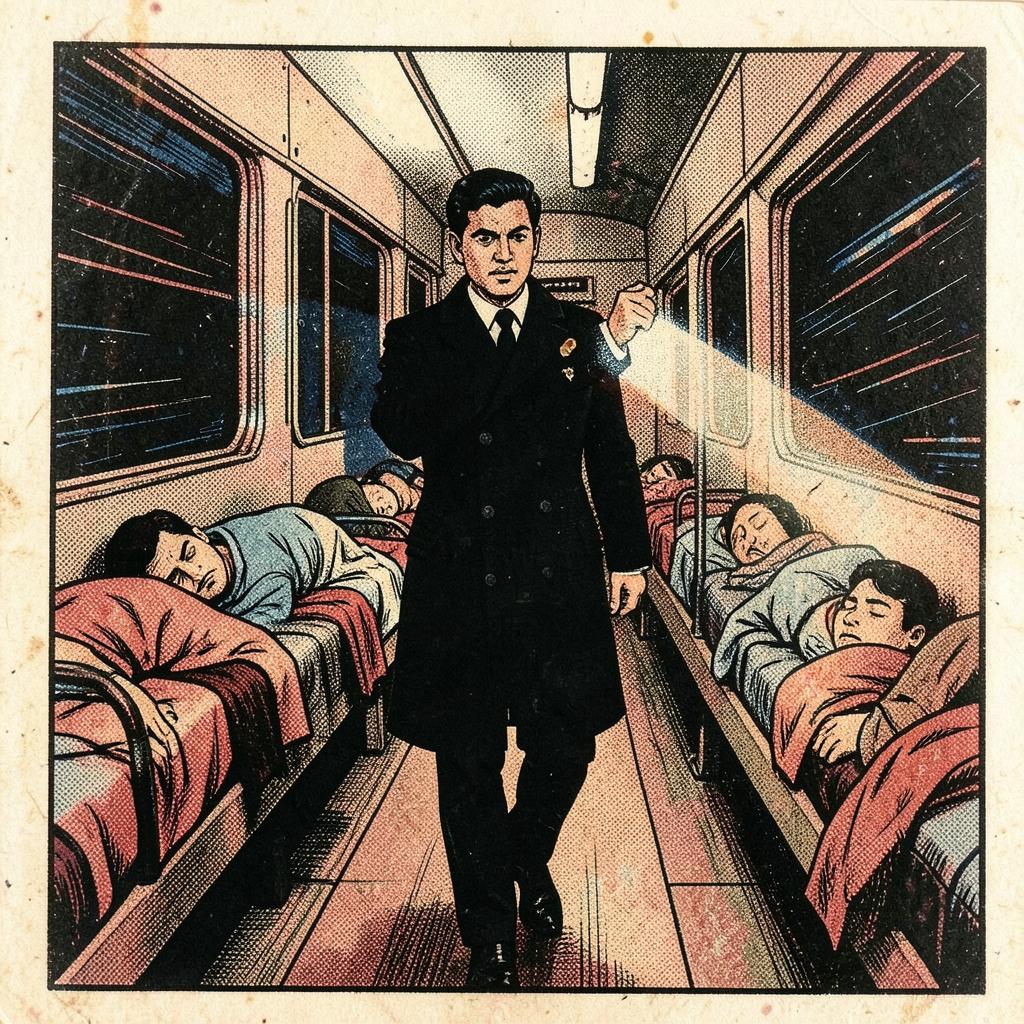
He rose steadily through the grades over the following decade, from junior checker to full Travelling Ticket Examiner, a post he has now held for over twenty years, moving through sleeper coaches at every hour of the night with a black coat, a punch, and a torch, and a rulebook he can, by his colleagues' account, recite by clause number without ever consulting the actual text.
The work took him, over the years, through eleven different states and into the retiring rooms of eleven different stations, each one furnished more or less identically with an iron cot, a ceiling fan of uncertain reliability, and a washbasin that ran cold water only, and Kishore has slept in enough of these rooms to have developed firm and specific opinions about which station's retiring room has the better mattress — opinions he shares freely with any junior colleague willing to listen.
He married Anjali in 1979, a match arranged through his mother, and their daughter grew up largely on a timetable of her father's postings, learning early to recognise the particular knock that meant he had a day's halt at home before the next outward journey — a knock Anjali still says she can distinguish from any other in the building even now, thirty years on.
Anjali keeps a wall chart in the kitchen marking out Kishore's month train by train, section by section, a habit she began in the first year of their marriage out of simple loneliness and has kept up ever since, out of what has become, by mutual unspoken agreement, a small household ritual, the chart filled in fresh each month in her own neat hand before he even departs.
His daughter's school functions, her annual day performances, her sports day medals, have mostly reached him as photographs mailed or later messaged to whichever station he happened to be passing through that week, and he keeps a modest album of these, arranged by date rather than by occasion, tucked into the same bag that holds his spare uniform and his rulebook.
There was an incident in 1991, still much discussed among his colleagues, when an elderly widow travelling without a valid ticket was found, on questioning, to have spent her last money reaching her son's cremation two stations ahead, and Kishore, rather than following the strict letter of the regulation, quietly arranged for her fare to be covered from a small collection among the coach's other passengers — a gesture he has never once mentioned himself, and which is known only because one of those passengers wrote a letter of appreciation to the railway zone office naming him specifically.
His uniform is pressed, without fail, somewhere on the train itself — a folded blanket for a board, an iron borrowed for the trip from the pantry car staff, who know him well enough by now to have one ready before he even asks — so that he steps onto the platform each morning appearing, to any passenger who has not seen the process, as crisp as if he had walked straight out of a laundry rather than off a berth.
He treats every passenger's ticket with the same exact and unhurried courtesy, whether it belongs to a first-class businessman or an elderly villager travelling unreserved, though the two are handled, by his own careful account, according to two entirely different and equally precise protocols — the elderly always offered a seat adjustment first, and told the rules only afterwards, gently, if at all necessary.
Colleagues who have served alongside him for years say that Kishore Barua has, by rough calculation, checked something in the order of ten lakh tickets over his career, and has, in all that vast travelling, never once taken a holiday trip of his own to anywhere he was not already required by duty to go — a fact he states plainly when asked, the way another man might state the number of years he has been married, neither complaining of it nor particularly remarking on it, simply setting it down as one more entry in a very long and orderly ledger.