From the annual — a life, told at length
Mahadev Naik
Night-Shift Watchman, Ambika Apartments (Wing B)
“He guards eighty-four flats and enters none of them.”
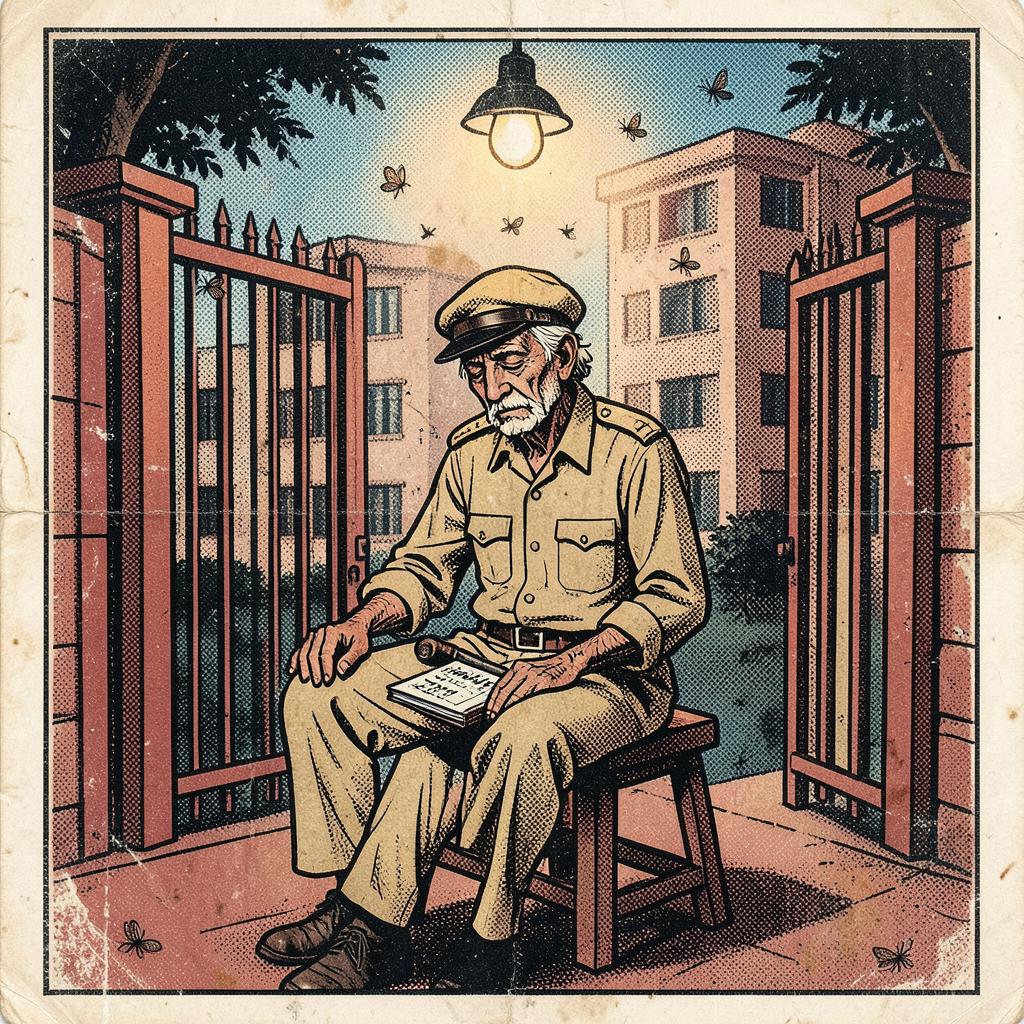
The Life, Told at Length
Mahadev Naik left his village near the Karnataka-Maharashtra border at twenty-two, when the family's small plot could no longer support his parents, two younger brothers, and the son just born to him and his wife Shanta, and a cousin already working in the city wrote to say there was a watchman's post going at a new apartment block called Ambika, Wing B, eighty-four flats, night shift only, decent pay.
He has held that post for nineteen years now. The building has changed hands of ownership committee four times, the security agency that technically employs him has changed twice, but Mahadev has remained the one constant at the gate, so familiar a fixture that new residents assume, for their first several months, that he owns the plastic chair he sits on.
His working night begins at nine and ends at six, a register open on his lap that almost nobody reads but that he fills in anyway, in a neat if slow hand, noting arrivals, departures, and the occasional delivery boy who overstays past a reasonable hour. He knows, without ever having been told, which car returns late and unsteady on a Friday, which second-floor balcony light burns till three during examination season, which flat on the fourth floor argues loudly on Sunday afternoons and makes up by Monday evening.
He goes home to his village for eight days each year, during the harvest festival, and the rest of the year is carried on by letter and, since 2001, by a mobile phone his son insisted he buy. In the photograph he still carries folded in his shirt pocket, his son Prakash is nine years old in a school uniform two sizes large; Prakash is twenty-two now, works in a garage in the nearby town, and speaks to his father on the phone in a polite, slightly formal tone that Mahadev has decided, out loud to no one, is simply how educated young men speak these days.
He sleeps through the hottest hours of the afternoon in a small room behind the generator shed provided by the building, a towel folded over his eyes against the light, and calls this arrangement, if anyone asks, “absolutely comfortable,” a phrase he has used so consistently over nineteen years that even Shanta, on her one visit to the city, took it up without irony.
One monsoon night in 2004 a fire broke out in the electrical room on the ground floor, and it was Mahadev who smelled the smoke first, at two in the morning, and went floor to floor himself, banging on eighty-four doors before the fire brigade arrived, getting two elderly residents down the stairs on his own shoulder when the lift failed. The committee gave him a certificate, framed, which hangs now in the security cabin, and a small bonus that he sent home the same week.
The residents of Wing B know him well enough to nod, to occasionally send down a plate of festival sweets, to ask after his health when the winter cough sets in, and yet by daylight, when their own working lives resume, most of them would struggle to say which of the two night watchmen on rotation was Mahadev and which was the other man, a fact he has noticed and has never once raised with anyone.
He keeps, in a tin box under his cot, a stack of letters from Shanta going back nineteen years, each one read many times, each one answered the same week it arrived, in his own hand, on the same lined paper he buys from the stationer near the bus stand.
Ask him whether the night gets long, whether eighty-four sleeping flats and one plastic chair make for a lonely occupation, and Mahadev will straighten in his seat, adjust the torch on his lap, and say that duty is duty, sahib, and that a man with eighty-four households under his care could hardly be called alone — and then he will resume his watch, upright, awake, and precisely where he has been for nineteen years, while the building above him sleeps on, entirely unaware of the hour of his relief.