From the annual — a life, told at length
Nirmala Joshi
Tuitions Taken, Std. V to VIII, Ground Floor Left
“First class first in 1991, and nobody in this house remembers it.”
The Life, Told at Length
Nirmala Joshi grew up the eldest daughter of a schoolteacher in a small district town, in a house where arithmetic was treated with something close to reverence, and where her father, unusually for the neighbourhood, insisted that his daughters be taught it as seriously as his sons — a small rebellion that cost him nothing in money but plenty in the raised eyebrows of relatives. Nirmala repaid the investment by topping every class she sat in, right through to her college finals, where she stood first in the entire university in Mathematics in 1991, a result that made the local paper and earned a framed certificate that still hangs, slightly crooked, in her mother's house two hundred kilometres away.
The marriage had already been arranged before the results were even announced, to a young man in a stable government job whose family was considered, by every reasonable measure, an excellent match, and the wedding took place that same season, so that Nirmala's triumph and her move into a new household arrived, as she puts it, almost in the same week, leaving little space between the two for anyone to properly celebrate the first.
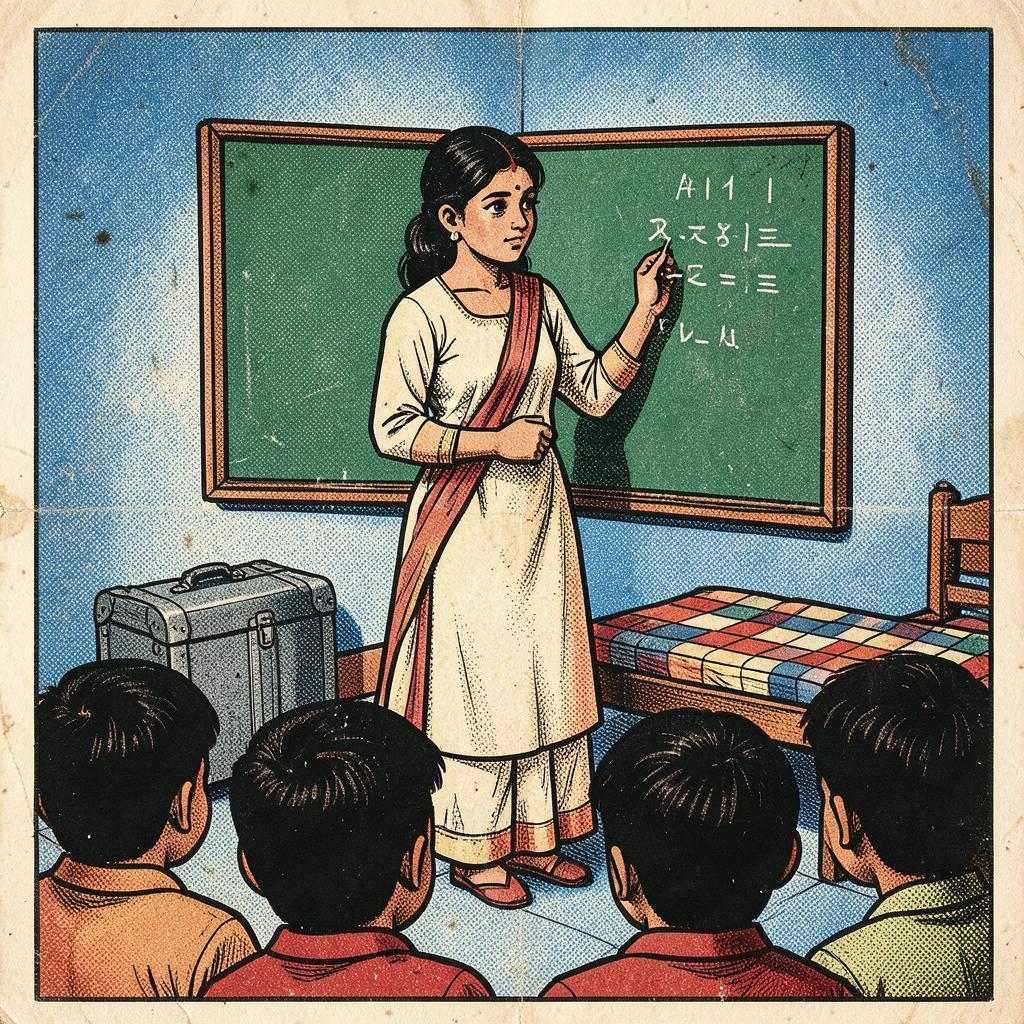
She filled out the admission form for an M.Sc. in 1993, fully intending to pursue it, and the form still sits, completed in her own careful hand, in a steel trunk in the storeroom of the flat she has lived in ever since, because in the two years that followed there was a baby, then a transfer for her husband, then a second child, and somewhere in that pile-up of ordinary, reasonable postponements, the form simply stopped being anything anyone discussed.
Her tuition classes began almost by accident, when a neighbour's son was struggling with his Std. VI mathematics and Nirmala, unable to watch a child fumble through a problem she could solve in her sleep, sat him down for an hour after school and fixed, in that single session, whatever had been wrong. Word travelled the way it does in a colony, and within two years her front room held, every weekday from four to seven, nine children of assorted ages bent over a green board she had painted herself.
Her fees have not changed in over a decade and, as the colony's mothers all agree, are embarrassingly low for what the children receive, but Nirmala waves away every suggestion of a raise with the same practised line: that the children's marks are the only fee that matters to her, and the rest is just a courtesy.
In 1997 a boy named Deepak, considered by his own school a hopeless case in mathematics, was brought to her in some desperation by his mother two months before his board exams, and Nirmala worked with him daily, at no extra charge, until the boy who had failed two internal tests that year scored seventy-one marks in the actual exam — a result the family still mentions to her every Diwali, and which Nirmala herself recalls, if pressed, with more warmth than almost any other subject.
Her own two children have grown up amid the daily arrival of nine other people's children, doing their homework at the same table an hour before the tuition batch arrives, and both, as things sometimes turn out, show only moderate interest in mathematics themselves — a fact Nirmala has mostly made her peace with, and mentions only in passing.
She corrects her students' exercise books each night after the last child has gone home, in red ink, in a hand so clear that other tuition teachers in the colony have been known to borrow her marked copies as a model for their own, doing this at the kitchen table once the household chores are done, the pressure cooker's last whistle of the evening usually sounding at exactly seven-fifteen, a small punctuation mark at the end of her working day.
The steel trunk with the 1993 form has moved house twice along with the rest of the family's belongings and has never once been opened for the purpose of throwing anything away, and Nirmala, when a visiting cousin once asked idly what was inside it, said only that it held old papers, then changed the subject to whether the cousin's own daughter needed help with her fractions.
Ask anyone in that colony who Nirmala Joshi is and they will tell you, without hesitation, that she is the reason half its children can do long division, that her queue of waiting parents runs a full year ahead, and that she once stood first in the whole university in a year that, they will add, feels now like a very long time ago — though nobody quite says why it should feel that way to her rather than simply to them.