From the annual — a life, told at length
Om Prakash Yadav
Head Coach, Shakti Akhara (Est. by his father, 1968)
“A body built like a promise the future did not keep.”
The Life, Told at Length
Om Prakash Yadav was born on the very ground he now teaches wrestling on, in a room next to the akhara his father Bhagwan Das Yadav dug and consecrated in 1968 with a coconut, a priest, and a promise to the district that Shakti Akhara would produce champions. Om Prakash was five years old when the wrestling pit was cut, and by the time he could properly read, he could also properly fall — a skill his father considered the more important of the two.
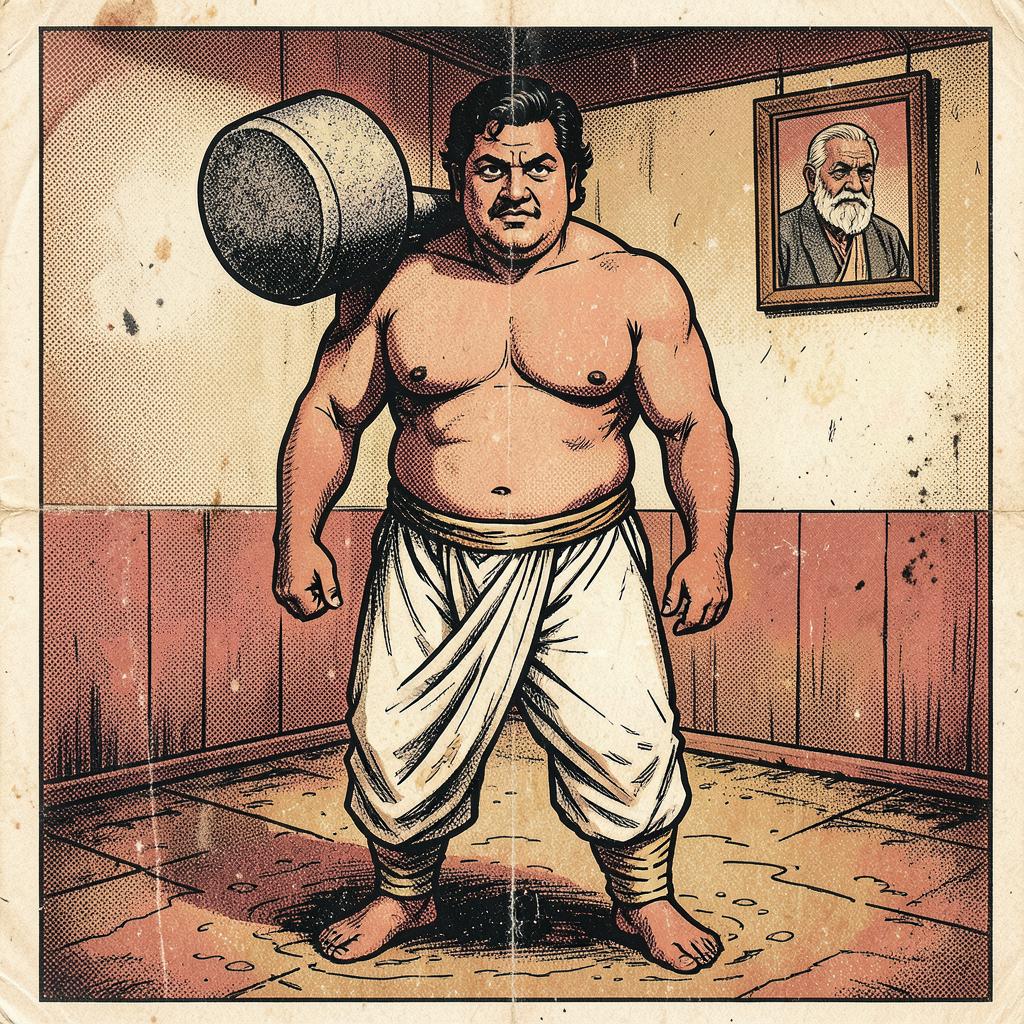
He grew into a build that neighbours still admiringly describe as built for the Olympics, shoulders too wide for the doorways of the family house, a chest his father would proudly thump in front of visitors as though showing off a prize vegetable at a fair. Training began before sunrise every day of his boyhood — a hundred push-ups, a hundred squats, the wrestling pit turned and watered and turned again until the earth was as fine as flour.
By eighteen he was winning district tournaments so regularly that the local sports pages grew tired of printing his name, and the whole akhara, indeed the whole neighbourhood, spoke of the state championship as if it were a formality still to be completed rather than a contest still to be won.
In 1988, at the state final in the divisional capital, Om Prakash lost his bout in ninety seconds to a wrestler from a rival akhara two districts away — a defeat so quick and unexpected that, as he tells it, the crowd fell into stunned silence before someone started shouting that the referee had been bribed. He has told this story more than any other event of his life, and the boys at Shakti Akhara today, none of whom were even alive in 1988, can recite the alleged crookedness of that referee almost word for word.
He did not wrestle competitively again after 1990, an ankle injury the following year making the decision for him the way such decisions often get made, and turned instead, at his father's urging and eventually his own conviction, to coaching the akhara his father had built, a role he has now held for over thirty years.
Under his guidance, boys arrive thin, scared of the mud, unable to finish twenty push-ups, and leave — those who stick with it — with shoulders and a bearing that mothers notice before anyone explains why. He speaks to them in commands even when the subject is vegetables at the market, a manner that unsettles strangers but reassures his students, who have learned to read affection in how loudly he shouts.
Two of his students, brothers named Rajkumar and Ravikumar, couldn't afford the doctor's fees when both fell ill with typhoid in the same season, and Om Prakash paid the bills out of his own pocket without telling their father, only to shout at the boys themselves when they later tried, shyly, to thank him for it.
His father's photograph hangs on the akhara wall above the ceremonial mace, garlanded fresh every Tuesday without fail, and Om Prakash still addresses the akhara each morning as if the old man were present to hear it — a habit the older wrestlers of the neighbourhood find touching and never mention to his face.
Even past sixty, he can still lift the heaviest of the training maces without much effort, and continues to insist, to anyone who'll listen at the tea stall in the evenings, that the boy who beat him in 1988 was no better a wrestler than himself, just luckier in his officials — a claim the district record books have long since stopped bothering to dispute, and which the akhara's newest recruits accept, the way they accept the sun rising, without question.