From the annual — a life, told at length
Prabhakar 'Prabhu' Naidu
Conductor, City Route 44-C (Twenty-Six Years, Same Route)
“He shouts at four hundred strangers a day and at no one who matters.”
The Life, Told at Length
Prabhakar Naidu — Prabhu to the whole depot and half the city besides — grew up in a one-room municipal quarter behind the bus depot, the son of a depot mechanic who could set a carburettor right by ear and expected his son to develop an equally sharp ear for something, though nobody in the family was quite sure what. Prabhu found his something at seventeen, when a family friend who conducted on Route 12 let him ride along for a week and hand out change, and by week's end the boy had discovered he could hold a whole busload of strangers in some rough, cheerful order just by the force of his voice.
He joined the transport corporation formally at nineteen, was posted to three different routes in his first four years, as new conductors always are, and was given Route 44-C in 1974 more or less by chance, when the previous conductor retired and nobody else wanted the long haul past the industrial estate. Prabhu wanted it. Twenty-six years later he is still on it, the only conductor in the depot's living memory to have kept a single route for a working lifetime, and younger men ask to be posted under him the way apprentices once asked to sit at a master craftsman's elbow.
The seventies and eighties on 44-C meant a wooden-slatted bus with a hand-cranked ticket rack, no fans, and a driver named Ganpat with whom Prabhu worked for eleven years without a single serious quarrel — a fact both men credit, separately, to Prabhu's habit of bringing extra peanuts on long shifts. He married in 1979, a soft-spoken woman from his own community named Lakshmi, and they raised a son and daughter in the same municipal quarter Prabhu grew up in — the daughter now a nurse, the son restless in a way his father finds hard to discuss over dinner but easy enough to discuss, indirectly, at every stop between Kasturi Chowk and the industrial gate.
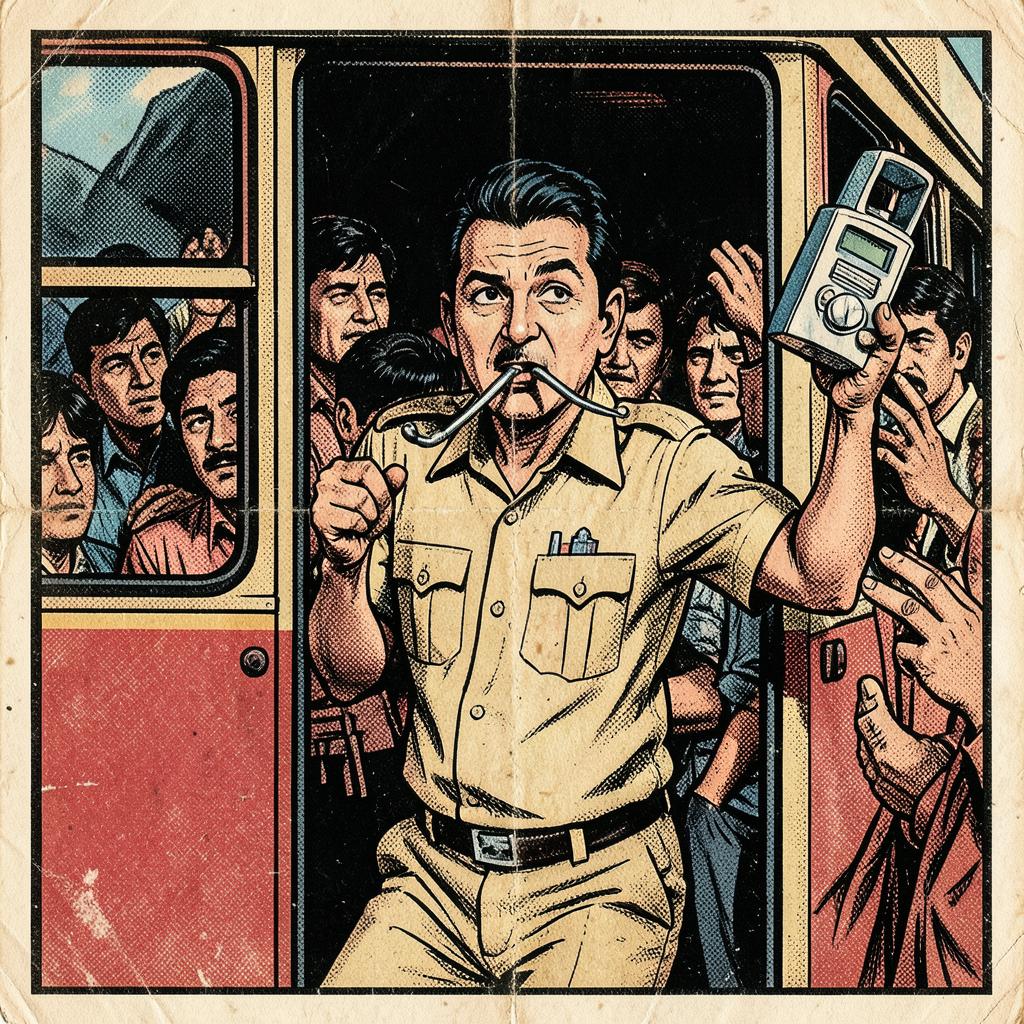
Prabhu's rules on the bus have never changed and are recited by regular passengers the way children recite a nursery rhyme: elderly people get a seat before they even ask for it, schoolbags are not left on empty seats, and no one, ever, under any circumstance, rides 44-C without a ticket while Prabhu is on shift — a claim generations of enterprising college boys have tested and never once beaten.
In 1986 a woman went into labour two stops short of the maternity hospital, and Prabhu, without any fuss, cleared the back three rows, told the driver to skip the remaining stops, and rode the last half kilometre standing at the open door, blowing his whistle continuously to clear the road ahead — an act the depot still half-jokingly commemorates by calling that stretch of road Prabhu's Corner.
He keeps roasted peanuts in his shirt pocket on every shift, a habit that began as a way to stay awake on the dull midday run and, over the decades, became so much a part of him that regular passengers now bring him fresh batches from their own kitchens without being asked, considering it a fair exchange for twenty-six years of punctual scolding.
At home he is a remarkably quiet man, as his wife and everyone else will tell you, given to long silences over his evening meal and short, careful sentences about anything that troubles him — a contrast the depot's younger conductors find almost impossible to square with the man who can be heard three platforms away calling out fares in a voice like a temple bell. It surprises anyone who knows him only from work.
When his son took a loan in Prabhu's name in 2019 without quite explaining the whole of it beforehand, Prabhu said very little about the matter to anyone, including, mostly, his son, and simply worked the extra hours the depot offered until the debt was cleared nineteen months later, after which he went back to his ordinary shift as though nothing had happened, telling the depot supervisor only that the accounts were now, thankfully, in order.
Passengers on 44-C today are mostly people who have never known any other conductor, and when the corporation once floated a plan to retire the old wooden-slatted buses and reroute 44-C entirely, three hundred residents signed a petition to keep the route and its conductor exactly as they were — a petition Prabhu still keeps folded in his ticket bag, not out of vanity, he says, but because a man likes to know his stop has been noted.
He will retire in four years, by his own careful count, and has already begun, in his quiet way, teaching a younger conductor named Suresh the exact order of every stop on 44-C, the exact pitch for blowing the whistle at a request stop versus a scheduled one, and the exact weight of a coin bag that has never, in twenty-six years, come up short at the end of a shift.