From the annual — a life, told at length
Pushpa Rane
Proprietress, Rane Tiffin Service (Home Delivery, 40 Dabbas Daily)
“She has fed a thousand bachelors and eaten alone since 1998.”
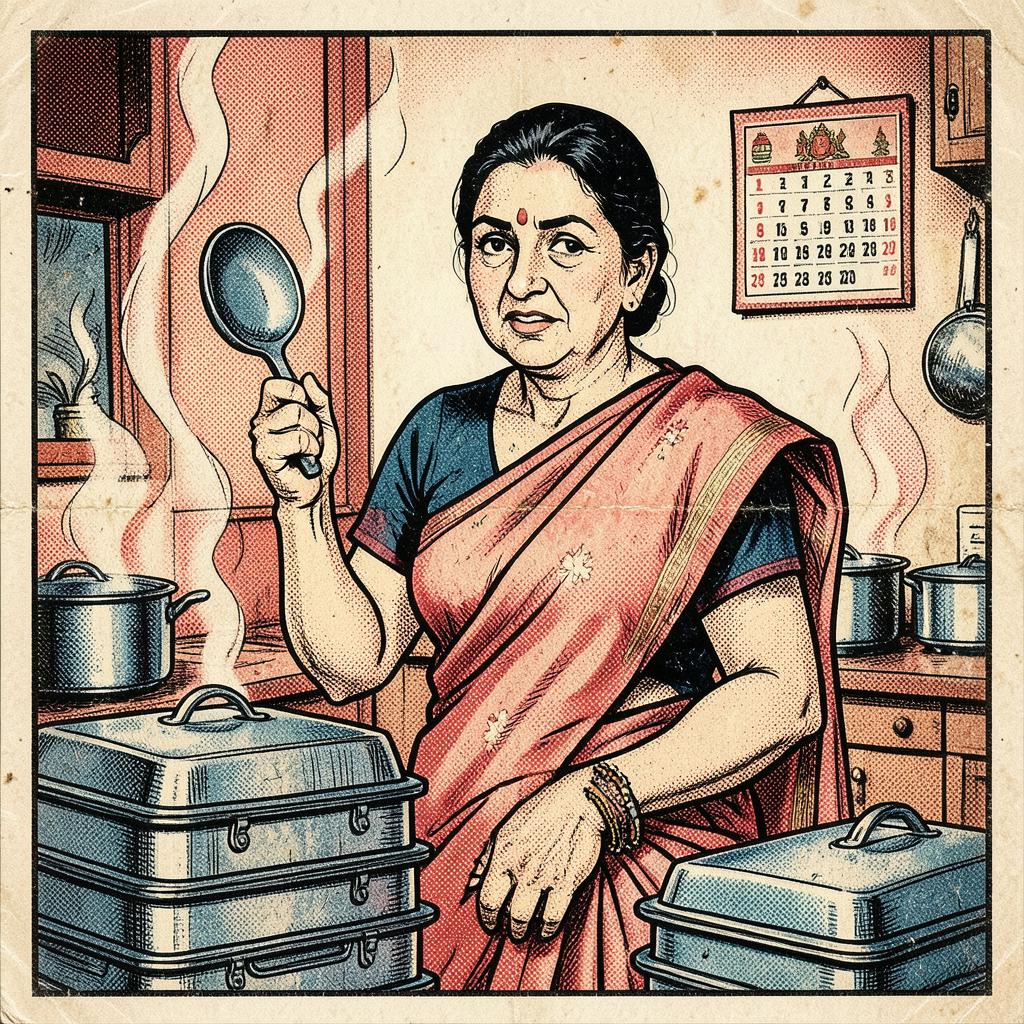
The Life, Told at Length
Pushpa Rane grew up in a one-room chawl in Dadar, where the walls were so thin that everyone knew everyone else's fights and everyone else's kheer. She was the third of five daughters, and her mother ran the whole house on a railway clerk's small pay, mostly through careful counting and clever cooking. From her mother she learned two important things that stayed with her for the rest of her life, guiding nearly every decision she made: a pot is never truly empty if you know how to make it stretch, and letting a guest leave hungry is a shame the house never lives down.
She got married at twenty-two and moved into a small ground-floor flat two lanes from where she still lives today. For twelve years she ran a kitchen that neighbours quietly praised, the way people take good health for granted until it disappears. Her husband managed a small hardware shop's accounts about as messily as he managed the home's, and when he died suddenly of a heart attack in 1998, Pushpa was only thirty-four, left with two children, a tangled set of bills, and an old, tired pressure cooker.
Her tiffin business started almost by chance. A bachelor engineer living on the second floor, tired of hotel food and too shy to ask directly, once mentioned that her cooking smelled like home. Within a month she was sending him two tiffin boxes a day. Within a year, that number grew to six. By 2003, a boy on a bicycle was delivering forty tins across three buildings, each one carefully labelled in her own handwriting so no bachelor ever got someone else's extra chapati by mistake.
Her kitchen follows a schedule stricter than any train timetable. The cooker starts at four in the morning, the mixer by half past, and by seven the first tiffins are stacked by the door in steel towers, still warm enough that the delivery boys unwrap them on the bus. In twenty-six years she has never sent out a tiffin she wouldn't want to eat herself, and there is always one extra spoon of ghee that never shows up on any bill.
The young men who eat her food call her Aai, and she keeps track of them like a schoolteacher keeping attendance — who has gone home for a sister's wedding, who hasn't called his mother in two weeks, who is sick and needs his dal made thinner for a few days. When one regular, an accounts trainee from Nagpur, was hospitalised with jaundice in 2011, she sent food to his hospital ward for three weeks and refused any payment, saying a sick boy far from home isn't a customer, he's somebody's son.
Sunday is mutton day, and news of it has spread across two colonies. Men who normally eat simply will walk half a kilometre out of their way on Sunday mornings just to make sure their name is on the list, and there have even been small arguments over latecomers and the last bit of gravy. Pushpa settles these disputes calmly, the way someone who has handled far bigger problems would.
She received two more marriage proposals after 1998 — one from a widower with a good pension, and, more surprisingly, one from a regular customer's uncle — and turned both down without much fuss, saying she was too old for such things, even though she was barely past thirty-five at the time. Her daughters, now grown and married into families two train stops away, still gently tease her about it, and she waves them off, ladle still in hand.
She always eats last of all, standing quietly at the counter around four in the afternoon, from a plain steel plate, finishing off whatever happens to be left of that day's cooking. She eats quickly because there's still washing-up to do before the evening batch begins. Ask how business is going and she'll simply say, very good, very good, the boys are eating well this month — as though the wellbeing of forty bachelors across three buildings were the only account book she has ever cared to keep.
So the clatter of tins begins every morning before the city has properly woken up, forty tiffins going out into the world stamped by one woman's hand. And if you ever wonder who is making sure you've eaten today, in that particular corner of the city, you can be fairly sure the answer wears an apron and calls you beta, whether you asked her to or not.