From the annual — a life, told at length
Ramesh Bhai Solanki
Auto-Rickshaw Driver, Permit No. 6-2231
“Twelve hours in traffic, arguing with a city that will not answer.”
The Life, Told at Length
Ramesh Bhai Solanki was born in a chawl behind the transport depot, the third of five children of a man who drove a municipal water tanker and treated the steering wheel like a badge of citizenship. From age nine, Ramesh sat beside his father on the long tanker route, learning the city road by road, and learning too that a horn, blown with real conviction, could settle arguments words never could.
He left school after ninth standard, not for any dramatic reason but because a cousin needed help with a borrowed rickshaw, and the rent on that rickshaw fell due on the fifteenth no matter whose education suffered for it. He drove other men's vehicles for nine years, on a fifty-fifty share that always somehow worked out sixty-forty against him, before he had saved and borrowed enough — two loans, one from a cooperative society and one, more costly, from a jeweller who financed such things quietly on the side — to buy Permit No. 6-2231 and finally call a rickshaw his own.
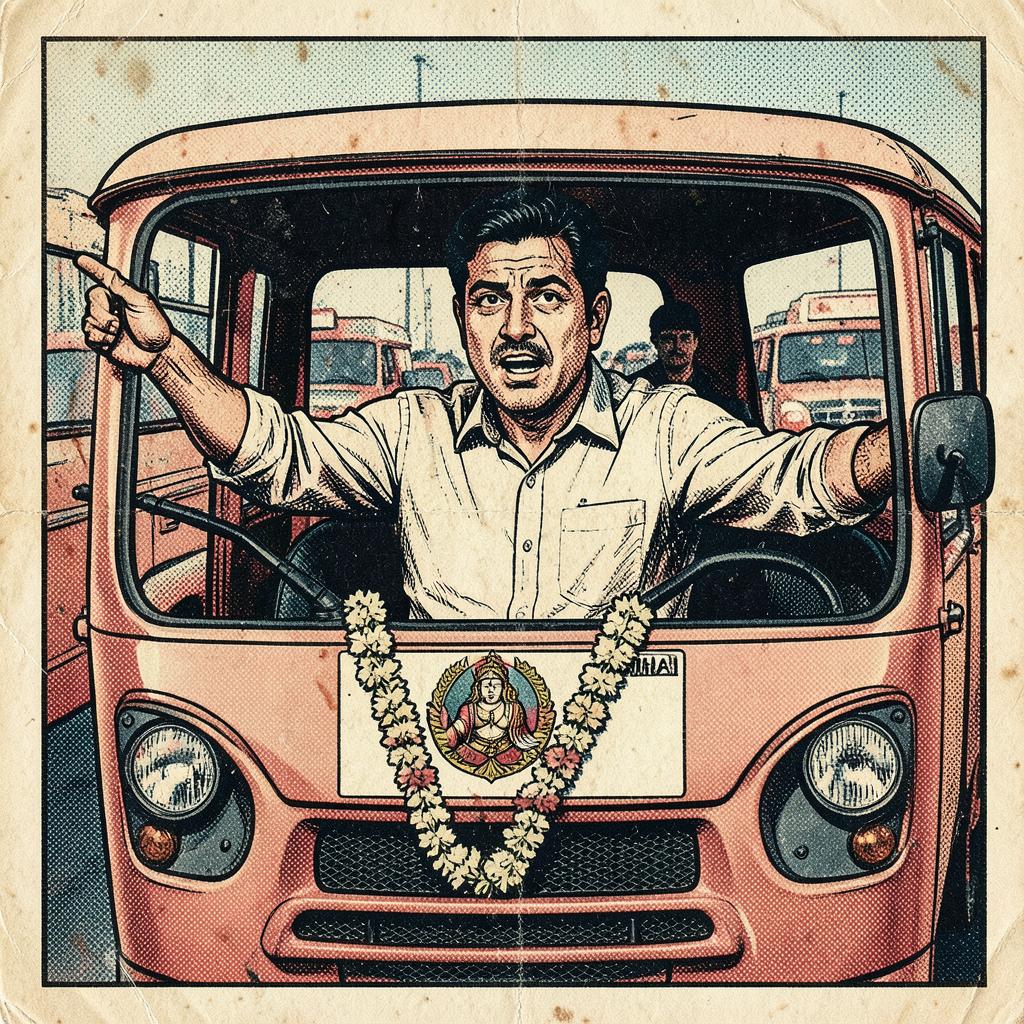
The rickshaw arrived a dull unpainted yellow-black, and within the month Ramesh had fitted it out with a small brass Ganesh on the dashboard, a string of jasmine renewed every second day by the flower seller near the depot, and a cassette player wired in by a mechanic friend who owed him a favour over a puncture kit. That cassette player has, since 1994, played exactly one singer, and Ramesh insists this is not stubbornness but taste.
His stand is outside the railway station, third in the queue behind two older drivers who treat him like a younger brother in need of correction, which he accepts loudly and rejects completely. He knows four genuine shortcuts through the old town, learned from his father's tanker days, and at least eleven more that save no time at all but express, in Ramesh's firm opinion, a finer understanding of the city than lesser drivers possess.
Every Sunday morning, before the day's passengers begin, he washes the rickshaw with a devotion other men save for temples — soap, a chamois cloth, a toothbrush for the chrome around the headlamp — while his wife hangs the week's washing on the line behind him and remarks, as she has for eleven years, that the vehicle is cleaner than the house. He does not argue the point.
There was the year of the fare revision agitation, when the union called a strike and Ramesh, ignoring the advice of the two older drivers, kept his rickshaw at the stand anyway and argued with three separate policemen about the constitutional right to earn a living, a phrase he had picked up from a passenger who turned out to be a lawyer. He was neither arrested nor especially persuasive, but he came home that evening prouder of himself than the day's earnings justified.
His daughter, a bright, unhurried girl now in her second year of a commerce degree, occupies a strange place in his conversation — he brings her up to nearly every fourth passenger, always as though the topic had arrived by accident, always followed by a description of her marks that grows more exact with each telling. He has never once told her this to her face; she hears it, third-hand, from neighbours who have shared his rickshaw.
In the traffic, twelve hours a day, six days a week, he gives whoever sits in the back seat a full report on the state of the nation — the road department, the new drivers with no discipline, the meter inspector who once fined him for what Ramesh still calls a misunderstanding of historic proportions. Passengers who ask a simple question about the fare often get, instead, a complete account of everything wrong with the city, delivered without malice and without any hope of being believed.
The neighbourhood has grown used to the sound of him before the sight of him, that particular note of the horn turning the corner by the water tank, and grown used too to the fact that whatever trouble the day has brought, he will, by evening, have found someone else entirely to blame for it. In a city that gives a man little enough credit for the hours he keeps, this is perhaps the only inheritance a horn and a windscreen can be counted on to provide.