From the annual — a life, told at length
Sarala 'Aunty' Pathak
Marriage Broker & Convenor, Colony Ladies' Committee
“Ninety-one matches made. One question never asked of herself.”
The Life, Told at Length
Sarala Pathak, known to three generations of the colony simply as Aunty, came to the neighbourhood as a new bride in 1975, married off within nine days of the proposal by a now-deceased aunt whose speed in such matters was, as the family tells it, practically a talent of its own. Sarala herself describes the arrangement, then and now and every year in between, as perfectly suitable, in exactly the same even tone no matter who asks or why.
Her gift for matchmaking revealed itself almost by accident when, at a cousin's wedding in 1979, she happened to mention to two mothers, separately, that their children might suit each other rather well, and turned out to be right within the year. By the mid-1980s people were consulting her formally, and by the 1990s she had become something close to an institution, carrying a plastic folder of horoscopes and photographs to every function she attended, on the sensible theory that opportunity doesn't wait for a formal appointment.
Her memory for family details rivals any government record: who owns land in which village, whose uncle has a drinking problem carefully left unmentioned at the first meeting, which girl turned down which boy in 2014 and the precise, often colourful reason why. By her own most recent count, she has made ninety-one matches, the vast majority of which she reports, with satisfaction, as still going strong.
She takes her fee only from the groom's side, a rule she states as though it were carved in stone, and refuses to discuss it further, though several members of the Ladies' Committee have over the years gently tried to work out the actual arithmetic of her earnings and been politely turned away each time.
The Colony Ladies' Committee, where she has served as convenor for eleven straight years, unopposed, conducts no real business until Aunty has finished her tea and shared her opinion, whether the topic is a garden dispute, a wedding hall booking, or the character of a family that has just moved into Block C. Her verdicts, once given, tend to become the settled facts of the colony.
She has an uncanny ability to sense unhappiness in other people's homes, often from the doorway itself, before the tea has even been offered — a skill neighbours find equal parts useful and unsettling, and one she uses freely while chatting with whichever family happens to be hosting her that afternoon.
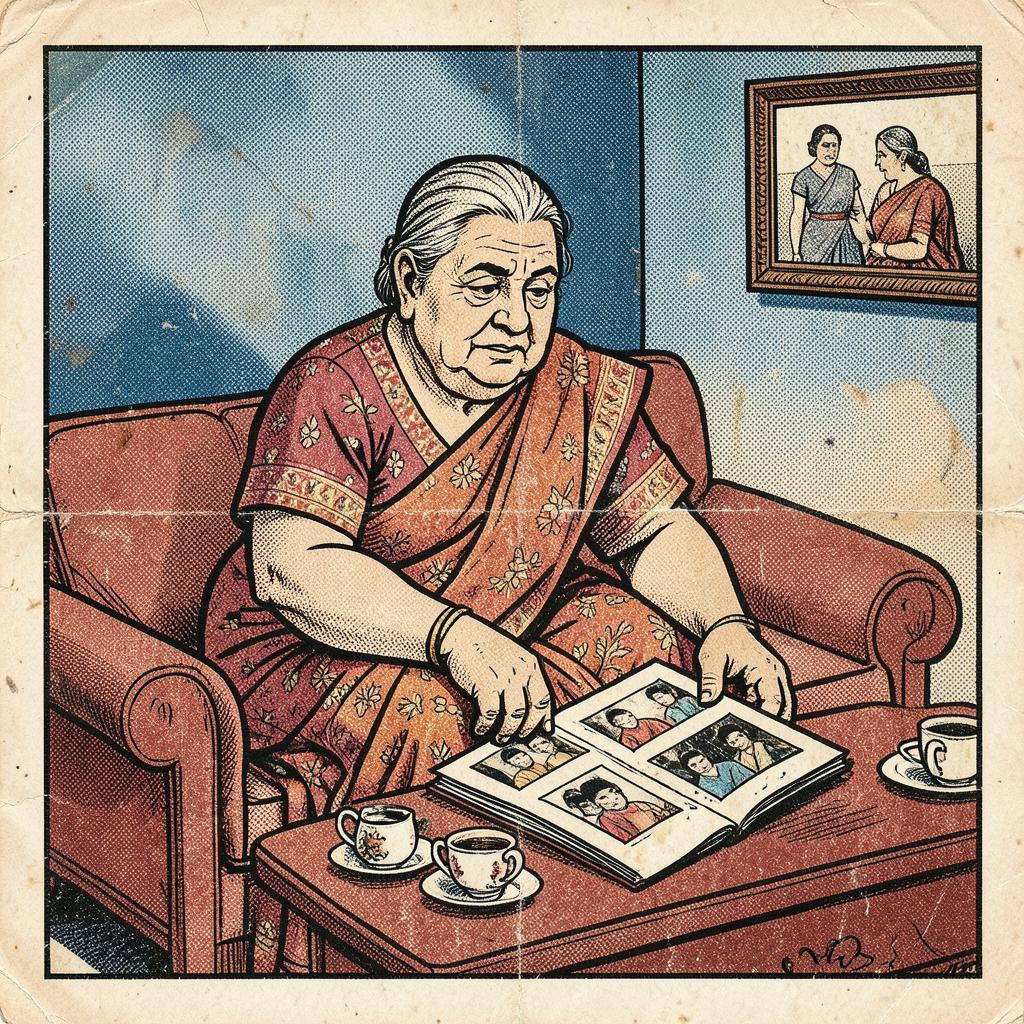
Her own household, by every outward measure, runs smoothly. Her husband Prakash Pathak, a retired bank officer, spends his afternoons at the club and rarely comes up in her conversation beyond the practical, and her two children, both settled abroad, call dutifully every Sunday. She keeps a framed photograph of her own wedding day prominently in the drawing room, a young bride garlanded and smiling nine days after the proposal that made her a Pathak.
In 2016 she pulled off what the colony still calls the Diwali Miracle, matching a thirty-four-year-old widow's brother-in-law with a divorced schoolteacher from two streets over, a pairing so unlikely that even her closest friends had doubted it, and one that has since produced, to Aunty's evident pride, two children and a joint family holiday to Goa every February.
Well into her sixties, she still arrives at weddings uninvited to the ceremony itself but essential to its planning, folder in hand, ready to point out which unmarried cousin present might suit which other unmarried cousin present, because in Sarala Pathak's considered view, the work of building a household is never really finished, only passed on, fittingly, from one generation to the next.