From the annual — a life, told at length
Yusuf Ali
Cycle Repair Mechanic, Corner of Nala Road
“He mends what others abandon, and calls it nothing special.”
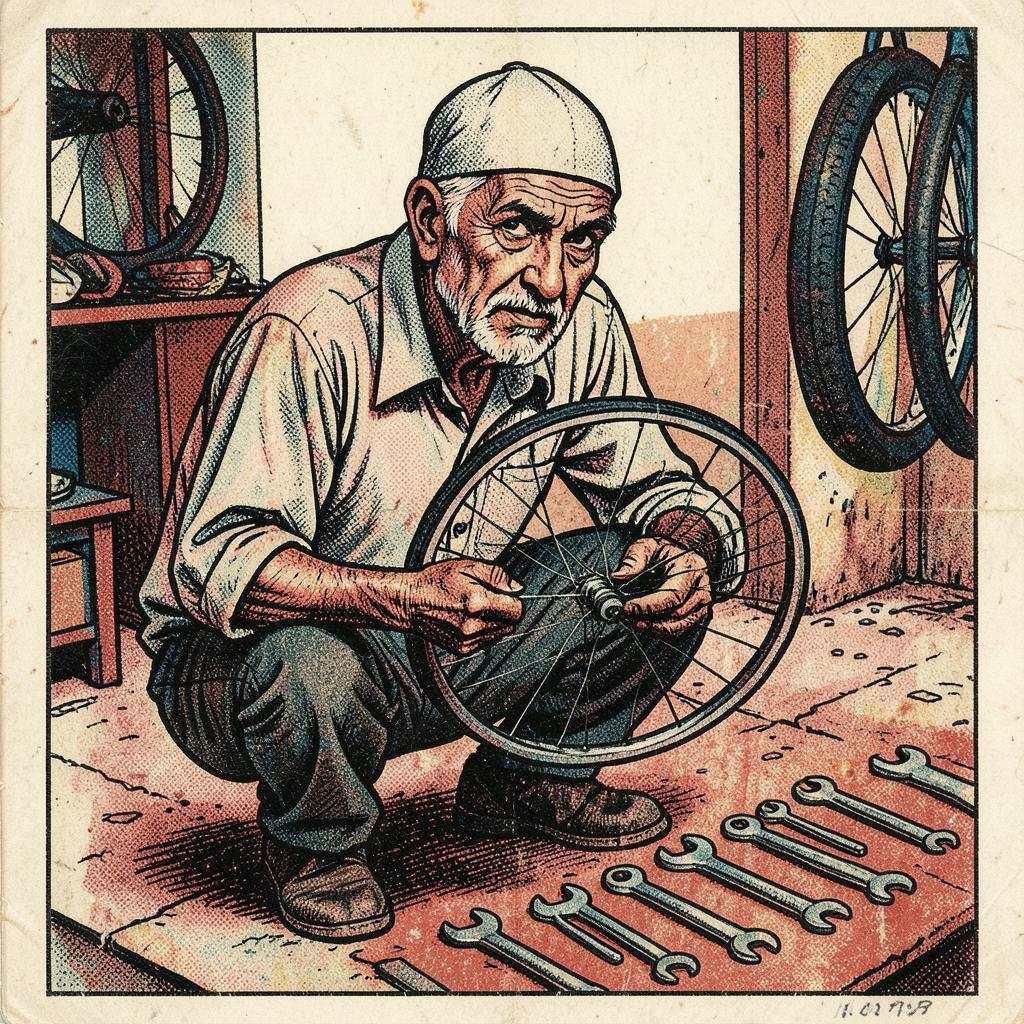
The Life, Told at Length
Yusuf Ali set up his little three-foot repair stall on Nala Road in 1953, back when the road was more open drain than road, and he has not moved from that spot since — except for the two years the municipality dug up the drains and, in his words, made everyone's life a real circus. He learned the trade from his father, who had learned it from an uncle in Amritsar before Partition sent the family south with little more than a toolbox and a habit of never complaining.
The tarpaulin roof over his stall has been patched so many times that, honestly, it is now just one big patch, held together by a system only he understands and would be offended if you questioned. Underneath it, his spanners and levers lie in a row that looks messy to a stranger but is actually a precise arrangement, built up over four decades, of exactly what his hand will need next, and in what order.
Every boy in the lane learns, sooner or later, that a punctured tyre tube can be brought to Yusuf-chacha for free, or for whatever small coin he happens to have, which in practice comes to the same thing. Their fathers stopped offering to pay him properly long ago, having learned that the offer visibly embarrasses him, as if being treated fairly were something he had to deflect with a cup of tea.
During the communal unrest of 1993, when a curfew held the town for nearly two weeks and certain lanes suddenly became unsafe for certain families, Yusuf gave up the back room of his own house to two Hindu families from three doors down, cooked for them from his own supplies for nine nights, and never once brought it up afterward. It is other people who tell that story now, in careful voices, and if Yusuf happens to be present when it's told, he'll interrupt to say the story has grown in the retelling, and would everyone like some tea.
He married late, at thirty-one, to a schoolteacher's daughter named Zubeida, who kept the household accounts with a precision he never managed for his own affairs. Together they raised three children in two rooms above a cousin's shop, sending the eldest all the way through a mechanical engineering diploma on Yusuf's daily earnings and a discipline about spending that the neighbours found almost funny.
His regular customers are countless and mostly nameless to outsiders — the postman's cycle, the fish-seller's cart, the school peon's ancient Hercules bicycle that has been declared dead and brought back to life more times than anyone can count. He remembers each machine's particular trouble the way a doctor remembers a patient's medical history, and greets returning bicycles with something close to real affection.
Some years back, a big showroom opened two lanes away selling shiny new bicycles on easy instalments, and everyone predicted it would be the end of Yusuf's footpath business. That showroom is now a mobile-phone shop. Yusuf is still there on his footpath, a fact he only mentions when asked directly, and even then with a shrug rather than any pride.
His own bicycle, the black one he rides home each night at nine past the shuttered shops, has had a wobble in its front wheel for six years that he has never once fixed — a small, curious exception in a life otherwise spent making other people's wheels perfectly straight. When this is pointed out to him, he laughs and says a mechanic's own machine is always last on the list.
So the tarpaulin stays up through another monsoon, and the row of spanners stays exactly where it has always lain, and somewhere on Nala Road right now a schoolboy is walking a flat tyre toward the one man in the district who will look at it, sigh with theatrical exasperation, and fix it for free, calling it, as always, nothing special.